
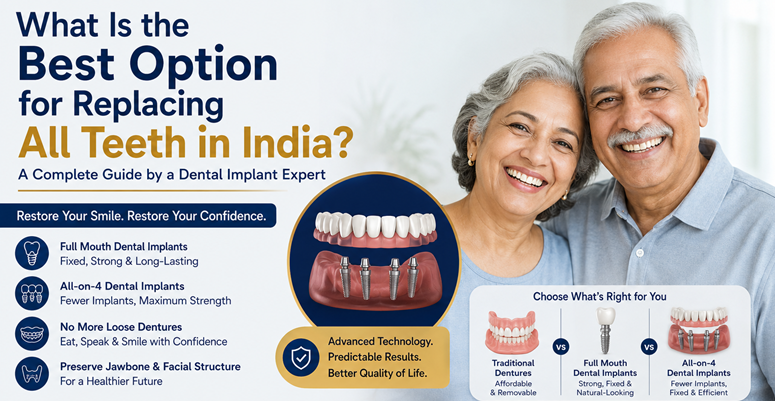
What Is the Best Option for Replacing All Teeth in India?
Losing all your teeth can significantly affect your confidence, ability to eat comfortably, speech, facial appearance, and overall quality of life. Fortunately, modern dentistry offers several effective solutions to restore a complete smile.
One of the most common questions patients ask is:
"What is the best option for replacing all teeth?"
The answer depends on several factors, including your jawbone health, medical history, lifestyle, functional needs, aesthetic expectations, and long-term goals. While removable dentures continue to be an option, advances in implant dentistry have made Full Mouth Dental Implants—particularly All-on-4 Dental Implants—a preferred solution for many suitable patients because they provide fixed teeth with excellent stability, function, and long-term outcomes.
This comprehensive guide explains the available treatment options and helps you understand which solution may be most appropriate for your individual needs.
Why Replacing Missing Teeth Is Important
Complete tooth loss is more than a cosmetic concern. Missing teeth can lead to:
Replacing missing teeth early helps restore oral function, maintain facial structure, and improve overall quality of life.
Option 1: Traditional Complete Dentures
Traditional complete dentures have been used successfully for decades and remain the most affordable solution for replacing an entire arch of missing teeth.
Advantages
Limitations
Despite their affordability, dentures have several disadvantages. Many patients report:
As the jawbone continues to shrink over time, dentures often become progressively looser, affecting comfort and function.
Best suited for: Patients seeking a removable, economical solution or those who are not suitable candidates for implant surgery.
Option 2: Full Mouth Dental Implants
Dental implants are titanium fixtures placed into the jawbone to replace missing tooth roots. Once integrated with the bone, they support fixed prosthetic teeth that closely resemble natural teeth in appearance and function.
Unlike removable dentures, implants remain securely anchored within the jawbone.
Benefits of Full Mouth Dental Implants
Because implants stimulate the jawbone during chewing, they help reduce the bone loss that naturally follows tooth loss.
For many patients, implant-supported restorations provide a substantial improvement in comfort, confidence, and everyday function compared with conventional removable dentures.
Option 3: All-on-4 Dental Implants – An Advanced Full-Arch Solution
Among the different implant-supported treatment options, All-on-4 Dental Implants have become one of the most widely used techniques for restoring a full arch of missing teeth.
Instead of replacing every missing tooth with an individual implant, this approach strategically positions four implants to support a complete fixed bridge.
By tilting the posterior implants, clinicians can often maximise the available bone while reducing the need for extensive grafting in appropriately selected patients.
Why Many Patients Choose All-on-4
When performed using Digital Smile Design, CBCT imaging, intraoral scanning, and computer-guided implant surgery, treatment planning becomes highly precise, helping optimise implant positioning and prosthetic outcomes.
Full Mouth Dental Implants vs Dentures
Stability
Dentures: Rest on the gums and may shift during function.
Dental Implants: Anchored into the jawbone, providing superior stability.
Chewing Ability
Dentures: Wearers often avoid hard foods.
Dental Implants: Allow many patients to enjoy a broader range of foods comfortably.
Jawbone Preservation
Dentures: Cannot prevent bone loss.
Dental Implants: Stimulate the bone, helping maintain jawbone volume.
Comfort
Dentures: May require adhesives and frequent adjustments.
Dental Implants: Function as fixed teeth without daily removal.
Long-Term Value
Dentures: Lower initial cost but may require ongoing relining and replacement.
Dental Implants: Although implants involve a higher initial investment, they often provide superior long-term function, comfort, and quality of life for appropriately selected patients.
Is Everyone Suitable for Full Mouth Dental Implants?
Not necessarily.
The ideal treatment depends on a detailed evaluation of several factors, including:
Bone quality and quantity
Gum health
Existing medical conditions
Diabetes control
Smoking history
Medications
Age
Oral hygiene
Functional requirements
Budget
A comprehensive examination—including CBCT imaging, digital scans, and clinical assessment—is essential before recommending the most appropriate treatment.
Why Experience Matters in Full Mouth Implant Treatment
Replacing all teeth is one of the most technically demanding procedures in implant dentistry. Long-term success depends on far more than simply placing implants.
Successful outcomes require:
Choosing an experienced implant team can significantly influence both treatment predictability and long-term success.
Why Patients Choose Burute Dental – Full Mouth Dental Implant Center & Dental Clinic
At Burute Dental, every treatment plan is customised using advanced digital diagnostics and evidence-based implant protocols.
Dr. Mrunal Burute
Chief Implant SurgeonDr. Mrunal Burute's experience includes:
- 10,000+ overall dental procedures completed
- 4,700+ successful dental implant cases treated
- Training more than 1,000 implantologists
- Key Opinion Leader for Dentsply
- Recognised among Nobel Biocare's Top 16 Train-the-Trainer experts in India
- Advanced expertise in complex full-mouth rehabilitation, immediate loading, and guided implant surgery
Dr. Madhura Burute
Chief ProsthodontistDr. Madhura Burute focuses on the prosthetic phase of implant rehabilitation—the design and fabrication of the teeth that are ultimately supported by the implants.
Her approach emphasizes natural-looking aesthetics, facial harmony, appropriate tooth size and shape, hygiene-friendly designs, comfortable chewing, and long-term maintainability.
Each patient receives an individualised treatment plan based on clinical findings, digital imaging, and long-term treatment goals rather than a one-size-fits-all approach.
Frequently Asked Questions
Dentures remain a practical option for many people. However, for suitable candidates, implant-supported teeth generally provide better stability, chewing ability, comfort, and jawbone preservation.
With proper planning, good oral hygiene, and regular professional maintenance, dental implants can last for many years. The longevity of the prosthetic teeth depends on factors such as materials used, bite forces, and routine care.
The procedure is typically performed under local anaesthesia, with sedation available when appropriate. Most patients experience manageable postoperative discomfort that can usually be controlled with prescribed medications.
Yes. Age alone is not a limiting factor. Overall health, bone quality, and medical suitability are more important than chronological age.
Dental implants are a well-established treatment with decades of scientific research supporting their use. Success depends on careful diagnosis, appropriate case selection, precise surgical execution, and regular follow-up care.
Final Thoughts
If you are searching for the best option for replacing all teeth in India, modern Full Mouth Dental Implants—particularly All-on-4 Dental Implants—offer an excellent balance of function, aesthetics, comfort, and long-term value for many eligible patients.
The most important decision, however, is not only choosing the right treatment but also selecting an experienced implant team that prioritises accurate diagnosis, transparent communication, evidence-based care, and long-term success.
If you are considering permanent teeth replacement, schedule a comprehensive consultation to understand which option is best suited to your oral health and lifestyle.
Book Your Dental Implant Consultation
Burute Dental – Full Mouth Dental Implant Center & Dental Clinic
Serving: Pimpri-Chinchwad (PCMC), Pune, Wakad, Nigdi, Ravet, Akurdi, Pimple Saudagar, Baner and nearby areas.
Important medical note: This article is intended for general patient education and does not replace a clinical examination, medical history assessment, X-rays, CBCT evaluation when indicated, diagnosis, or individualized advice from a qualified dental professional.